Showing posts with label exhibition. Show all posts

Friday, September 6, 2019

Considering color and aesthetics in the artwork of Nicole Galluccio.


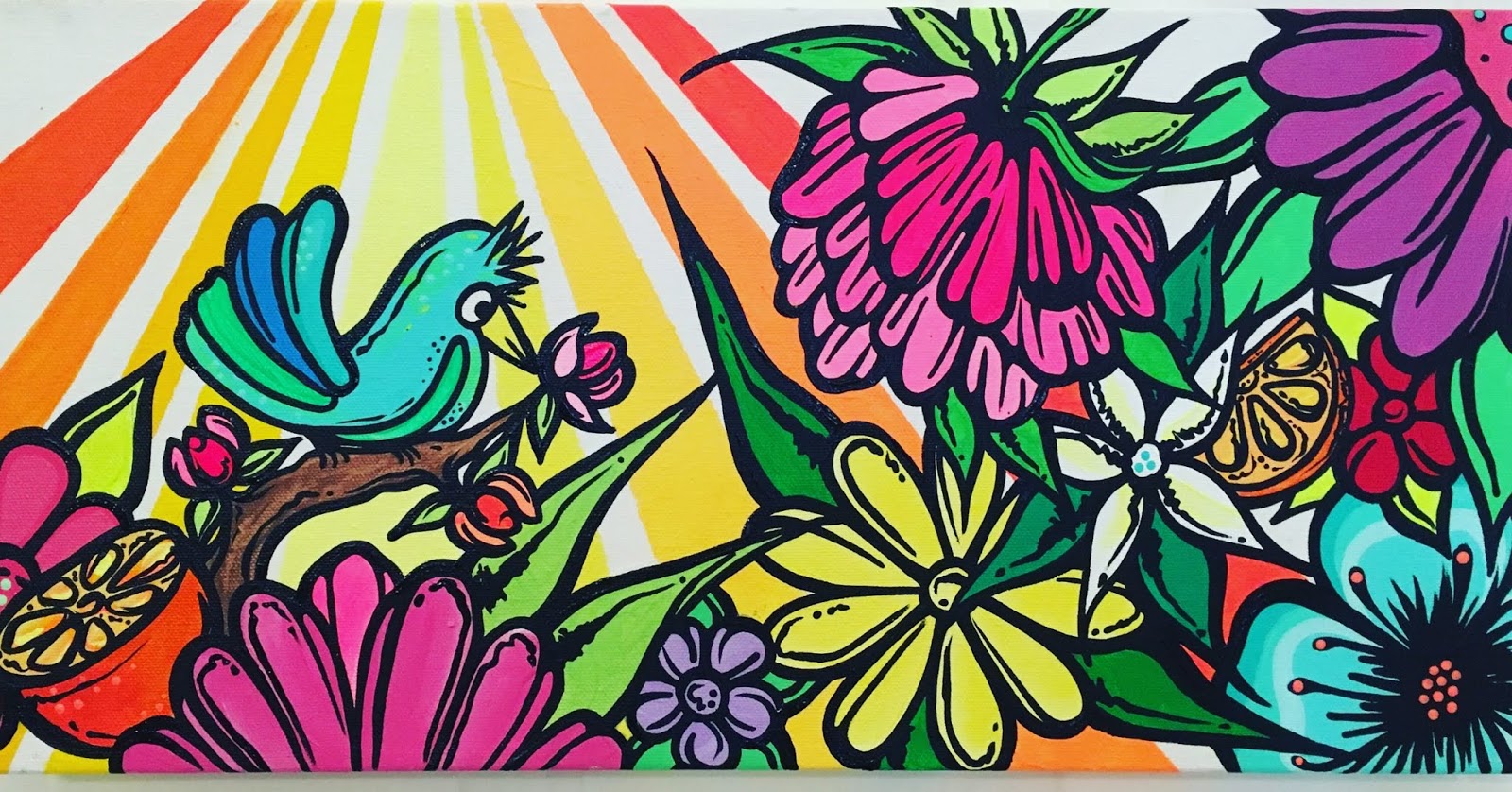
Looking at a painting by Nicole Galluccio induces a feeling of calmness and joy. With everything going on in the world right now, this is exactly what I needed to see. When you walk into her studio you walk into a bold, bright flower garden [evoked by her paintings] with a hot pink floor, and leave unexpectedly, with a smile on your face.

This is no accident. The work is process oriented. She established her painting practice on Color theory, which is the combination of art and science that determines what colors look good together. The bold designs mimic the color wheel and are rooted in the philosophy of aesthetics; studying how the mind and emotions appreciate beauty.

Her work references nature. Emerson said, “The simple perception of natural forms is a delight.” Nature dazzles the senses (Popejoy). Galluccio relies on this by using reoccurring motifs of flowers, sunshine rays, and character art based on wildlife. Everyone loves a good Disney film and her bird characters could be plucked right out of a Snow white picture. She relies heavily on geometric structure and often references the mandala, which denotes the universe in Buddhist symbolism.


Flowers have been one of the most beloved subjects to paint throughout art history.  From Bosschaert and Cassatt to Warhol and Quinn you can find many styles and techniques using flowers. The latter most resembling Galluccio’s intentions. Investigating contemporary artists, and looking at some of Galluccio’s older works [that include collage], my mind immediately references Brazilian artist Beatriz Milhazes. Mihazes also utilizes a rigorous geometric structure with recurring motifs. Like Galluccio, Milhazes feels her technique is most important to the work. Milhazes work intentionally creates a visual dissonance so the “viewer has something to do” when looking at the work. Galluccio’s work has the opposite, calming effect, but has similar qualities.


Moving on to Galluccio’s newer works, which include a smiling sun and flowers, I am of course instantly reminded of Takashi Murakami’s work. His work has historical techniques but heavily references pop culture, anime and cartoons which is directly in line with what I see in Galluccio’s work. I am drawn to the flatness of her work. The comic, printmaking techniques she achieves with a paintbrush are impressive. No one does a black line [freehand] better than she does. Murakami coined the term "superflat", which describes both the aesthetic characteristics of the Japanese artistic tradition and the nature of post-war Japanese culture and society. The artwork of Nicole Galluccio fits nicely into this contemporary art movement.


In the modern world artists are pushed to market themselves and sell their artistic output [Conversation]. Marketing yourself is now a necessity. Galluccio is well on her way to establishing herself as a brand. She not only paints, but also does an array of products [jewelry, furniture, and clothing]. Murakami has established himself as a pioneer of promoting art as a brand (Artnet). It will be interesting to see her development and collaborations if she continues moving in this direction.


For more information about Nicole Gallucio you can find her at the following
Instagram:  @nicolegalluccioart


The John D. MacArthur Campus Library will be hosting a small exhibition of her work 
Nov 15 – Jan 10, 2019(20)                                                                                    

Monday, August 5, 2019

Exploring character development in the art works of Dana Donaty

Written by Diane Arrieta

             Dana Donaty. Maestro. Acrylic on canvas. 2016


When you first encounter the work of Dana Donaty, you are hit with a profusion of color and fairytale-like narratives that explode on her canvases. It takes a while to settle into one of her paintings. But when you do, you can get lost for hours discovering the characters and the stories summoned by her stockpiled memories. How did they get there? Do they exist outside of Donaty’s paintings and imagination? Why are some of them so familiar to us?

To examine how her character art becomes transformed into picture, there are two important aspects of the work that must be examined: the how and the why. Many artists focus on the “how” they make their art, while others focus on the “why” they make their art. Donaty’s work demands viewers to examine both the how and the why. The process and the purpose of her work are rooted in her cultural identity of growing up in an American nuclear family. This idea is very apparent when studying the work of artist Jaune Quick-to-See Smith. Her cultural identity and socio-political views are embedded in her art and cannot be separated (Quick-to-See Smith, 2019). Although Donaty employs a more subtle approach with her social views, the how and the why should not be separated when considering Donaty’s work.


An overview of Character Art:

Character art refers to an original figure that an artist, illustrator or animated film designer creates from scratch. The concept, style, physical characteristics and personality traits of the character (human or otherwise) are all decided by the designer. Developing a new character requires the artist to embark on “a creative dive into the unknown and from the abyss, pull out a new design” (Concept Art Empire, 2019).

There is no wrong way to approach character development, and each artist or designer settles into their own methods. They gain inspiration everywhere from animated film, television, advertisements, cereal boxes, and more (Creative Blog, 2019). Designing a 2-D character is slightly different than designing for an animated 3-D film. For a painting, the artists needs to consider one angle. A 3-D character requires the character to be seen from all angles. One interesting aspect of Donaty’s art is that her characters begin flat in the painting; however, she also explores bringing them to life outside of the painting into the 3-D realm. One of her first characters that has made the leap outside of a painting is Captain Money Pants (shown below). Donaty is currently working toward bringing several of her characters to life by means of a variety of different mediums.


                                                                            Captain Money, Pants. Mixed Media. 2017

The How:

Indulging a Donaty painting begins with exploring her unique process of employing Visual Pareidolia.  “Pareidolia is the interpretation of previously unseen and unrelated objects as familiar due to previous learning” (Akdeniz, et al., 2018). Pareidolia in the visual arts has been discussed since the time of Leonardo da Vinci (McCurdy, 1923) and is still in use today by several contemporary artists. Artist Gigi Chen, an animator and painter uses nature and urban artifacts when she engages her version of pareidolia to her work (Chen, 2019). Italian artist Maggio uses coffee stains for the base of his work (Maggio, nd) and Illustrator Keith Larson also develops characters out of inanimate urban objects he encounters (Marini, 2017).

The scientific reasoning for the phenomenon of pareidolia stems from the fact that our brains use parallel processing. We find patterns and make associations that are sifted through our memory. This is an active constructive process. We quickly find a possible match and assign it a name. For example when you see a duck in the clouds. You assign it that name, and the brain fills in the details to make the cloud resemble your assigned name for it (Allen, 2018).

Donaty’s process begins each painting with a large canvas on the ground used as a drop cloth where splattered paint, offloading of brushes and dirty water are all caught on this blank canvas as she paints on a separate canvas above it. The backstory of this process relates to her practical physician father and his “waste not want not” conditioning of Donaty, when she worked in his medical office as a child. Because of her upbringing, she now recycles everything. This has had a direct influence on her art practice and character development.

The process of employing visual pareidolia for her character development, begins when she lifts the dirty canvas up onto the wall as the base for her next work of art (illustrated below). She stands back and starts to explore the emerging characters that form a narrative for the work. She chalks them out and then constructs a guided storyline.


                                                        Studio shot: Dana Donaty Fine Art
                             
Just like the visual development artists at Disney animation studios, Donaty is a master at manipulating her pictorial environment while her characters form an emotional connection (Disney, 2019) through her technical prowess with a brush. She manipulates the scene to direct the viewer on the start of a magical journey that leads wherever their own imagination and social recall takes them. As the story develops, Donaty always adds in a larger than life human into the mix. The characters determine the providence of her humans within the context of the painting.

The why:

As stated above, inspiration for character development can come from a wide variety of sources and stored memory. One aspect to understanding the context of the character worlds found in a Donaty painting requires consideration of the impact American television has had on culture and society (Novak Djokovic Foundation, nd). Early television programming during the 60s and 70s, was created for the presumed White audience. It intentionally avoided social issues and real-life concerns in order to not offend or alienate viewers (Encyclopedia.com, 2019). Conversely, popular in that time were Saturday morning cartoons. Cartoons teach kids how things function in real life, while offering ways of dealing with difficult situations (Novak Djokovic Foundation, nd).

The most prevalent shows for adults of that era were domestic comedies—generic, character-based shows set within the home (UMass, 2019). Donaty was being conditioned to avoid conflict through comedy, but was also given the license to add in social commentary, predisposed by weekly cartoons. After interviewing Donaty in a recent studio visit, she mentioned two main influences that were core to her childhood memory: Carol Burnett and Charles Schultz. 

Carol Burnett broke a lot of barriers in society by starring in her own variety show, and today is viewed as a feminist comedic hero. Not by the content or intent of her show, but by the mere fact that she was fearless and did what no other women were doing at the time (Duca, 2015). Donaty grew up watching Burnett’s cast of fictional characters act out scenarios for a big laugh, week after week. I can see similar qualities in Donaty herself—bucking the trends in the art world and sticking with her often underestimated character world. Her paintings are a kind of variety show with each painting a new episode of zany scenes and characters offering Donaty’s take on society.

There have been many cultural studies on how humor can be a tool that helps people deal with complex and often contradictory messages in our brains (Weems, 2014).  Donaty’s paintings can be viewed as ordered chaos. At first confusing, but looking closer, you start to see familiar faces and text integrated into a burst of color. It offers an entry point of exploration through a societal lens of icons and meanings derived from our collective consciousness [Sociology Index, 2001].

Humor as an artistic tool has been used throughout art history. When we look at the work of John Baldessari, his humor calls attention to existing absurdities (Mizota, 2010). Artists have been using objects as joke since the infamous Duchamp urinal, while Richard Prince recasts found objects to make us rethink how culture operates (Lee, 2017). The one artist that gives off the same vibe as Donaty is David Shrigley. As Lee states, his works are true and relatable as much as they are discomforting and just plain weird (Lee, 2017). One could have similar feelings about a Donaty painting.
Charles Schultz, creator of the famous Peanuts comic strip and subsequent television shows, is part of most [White] American family memories. What most people didn’t realize, is that Schultz was very religious. “By mixing Snoopy with spirituality, he made his readers laugh while inviting them into a depth of conversation uncommon to the funny pages” (Merritt, 2016).
                           

                                           Dana Donaty. Top Dog. 60 x 48 inches. Acrylic on canvas

Many of Shultz’s comics were cryptic and with blanks where the audience must fill in the gaps. As Merritt states, “the result is that readers become participants of the strip’s conversation instead of merely spectators” (Merritt, 2016). The same can be said about Donaty’s works. They are starting points for stories that can be directed by the viewer. We can see this in the work pictured above (Top Dog). It could have several different interpretations. Is the human the corporate pied piper calling on the masses to follow along, or are the characters critics analyzing the musician’s performance? The possibilities are endless and open to interpretation. Donaty sneaks in clever text and images that need to be deciphered by the viewer. There is even reference [in Top Dog] to Marcel Duchamp and the Mona Lisa, with the L.H.O.O.Q. text providing a glimpse into the understated humor of Donaty.

The characters in Schultz’s body of work are immediately endearing. They give hope, but at the same time offer a bit of skepticism. Donaty’s characters do the same. From Captain Money Pants to hints of Donald Duck and Yosemite Sam, the viewer instantly becomes reminiscent of their own childhood that these invented and borrowed characters conjure up. The added text and scenes often have a bite like the cynical retort found in a Peanuts comic. Schultz’s Linus character offers up “I love mankind… it’s people I can’t stand” (Charles Schultz Museum, 2011), which falls directly into the psyche of Donaty herself.

Peanuts comics are a spectacle of little children afflicted with adult concerns (Charles Schultz Museum, 2011). Donaty’s work may appeal to children at first sight, but is entertaining adults with advanced topics and subtle commentary. Just look at the sculptural Captain Money Pants’ hand gestures. Who is that directed too? Society, the art world, nay-sayers of her work? You decide. The reoccurring dollar signs in many of her paintings give a new layer of context to the work. They could allude to the consumer driven cartoons and commercials that try to sell products to children (Klein, 2010) or the money driven art world.
Donaty’s skill at using her own unique character design mingled with iconic characters of Disney and other relevant popular cartoons allows a sense of nostalgia for childhood. They do their job at creating an inviting environment to explore. Donaty offers the same journey of escapism of the comedic variety show, while proposing the chance of a larger conversation hidden within cartoons—for those willing to enter the mesmerizing world that is the art of Dana Donaty. 

References: 

Akdeniz,G., Toker, S.  and Ibrahim Atli , 2018. Neural mechanisms underlying visual pareidolia processing: An fMRI study. Pakistan Journal of Medical Sciences, 31 Dec. 2018, p. 1560. Health Reference Center Academic,  http://link.galegroup.com/apps/doc/A565606403/HRCA?u=gale15691&sid=HRCA&xid=2681521e . [Accessed 6/18/2019].

Allen, M., 2018. This Is the Evolutionary Reason We Often See Human Faces Not on Humans. Inverse.com. Online. Available at: https://www.inverse.com/article/49527-what-is-pareidolia  [Accessed on 6/28/2019].

Charles Schultz Museum, 2011. Peanuts Philosophies. Online. Available at: https://schulzmuseum.org/explore/press-room/peanuts-philosophies/   [Accessed on 6/27/2019].

Chen, G., 2009. Seeing Things in Things. Artist Network. Online. Available at: https://www.artistsnetwork.com/art-subjects/seeing-faces-in-objects-pareidolia-gig-chen/ [Accessed on 6/26/2019].
Concept Art Empire, 2019. What is Character Design? And What Does A Character Designer Do?. Online. Available at: https://conceptartempire.com/character-design/   [Accessed on 6/28/2019].

Creative Blog, 2019. 27 top character design tips. Online. Available at: https://www.creativebloq.com/character-design/tips-5132643  [Accessed on 6/28/2019].
Disney, 2019 Visual Development. Online. Available at: https://www.disneyanimation.com/careers/opportunities/developing-appealing-characters [Accessed on 6/25/2019].

Duca, Lauren, 2015.  Carol Burnett Is A Feminist Hero Whether She Knows It Or Not. Huffington Post. Online. Available at: https://www.huffpost.com/entry/carol-burnett-feminist-hero_n_55f866a3e4b00e2cd5e835b8  [Accessed on 6/25/2019].
Encyclopedia.com, nd. "Television's Impact on American Society and Culture." Television in American Society Reference Library.  Online. Available at https://www.encyclopedia.com/arts/news-wires-white-papers-and-books/televisions-impact-american-society-and-culture  [Accessed on 25, 2019]

Klein, S., 2010. Study: Cartoon characters attract kids to junk food. CNN Online. Available at: http://www.cnn.com/2010/HEALTH/06/21/cartoon.characters.junk.food/index.html [Accessed on 6/28/2019].
Lee, S., 2017. LOL: A Brief History of Comedy in Art since Duchamp's "Fountain". Artspace. Online. Available at: https://www.artspace.com/magazine/art_101/lists/lol_a_brief_history_of_comedy_in_art_since_duchamps_fountain-55132 [Accessed on 6/28/2019].

Maggio, 2017. Pareidolia: I Draw The Images I See In Stains. Bored Panda. Online. Available at: https://www.boredpanda.com/pareidolic-art-drawing-on-stains-maggio-modlin/?utm_source=google&utm_medium=organic&utm_campaign=organic  [Accessed on 6/25/2019].

Marini, A., 2017. This Guy Illustrates The Faces He Sees In Inanimate Objects. A Plus. Online. Available at: https://articles.aplus.com/art-seen/keith-larsen-faces-in-inanimate-objects?no_monetization=true [Accessed on 6/26/2019].
Mizota, S., 2010. It's OK for serious art to be funny. LA Times. Online. Available at: https://www.latimes.com/archives/la-xpm-2010-aug-15-la-ca-art-humor-20100815-story.html [Accessed on 6/28/2019].

McCurdy, E., 1923. Leonardo Da Vinci S Note-Books Arranged And Rendered Into English. Empire State Book Company, NY, New York.

MERRITT, J., 2016. The Spirituality of Snoopy: How the faith of Charles Schulz, creator of the Peanuts comic strip, shaped his work. Online. Available at: https://www.theatlantic.com/entertainment/archive/2016/04/the-spirituality-of-snoopy/479664/  [Accessed on 6/27/2019].

Quick-to-See Smith, 2019. Biography. Online. Available at: https://www.jaunequicktoseesmith.org/ [Accessed on 6/28/2019].
Sociology Index, 2001. Collective Identity and Social Movements. Annual Review of Sociology, Vol. 27: 283-305 Online. Available at: http://sociologyindex.com/collective-identity.htm  [Accessed on 6/27/2019].

UMass, nd. The Relationship Between Television and Culture. UNDERSTANDING MEDIA AND CULTURE: AN INTRODUCTION TO MASS COMMUNICATION. Class Notes. University of Massachusetts. Online. Available at: https://open.lib.umn.edu/mediaandculture/chapter/9-2-the-relationship-between-television-and-culture/ [Accessed on 6/25/2019].

Weems, Scott, 2014. Ha! The science of when we laugh and why. Basic Books. New York, N.Y.

Author Biography
Diane Arrieta is the Outreach and exhibitions coordinator at the John D. MacArthur Campus Library at Florida Atlantic University. She has been curating contemporary exhibitions since 2005. Arrieta, a visual artist herself, works with sculpture, video and illustration. She is currently exploring environmental themes in her work. Arrieta was born and raised in Western Pa, now living in South Florida. She holds a BFA in ceramic sculpture from Florida Atlantic University and an MSc in Biodiversity and Wildlife Health from the University of Edinburgh, U.K.
Personal website: http://www.birdsarenice.com

Artist information
Dana Donaty
Dana Donaty was raised in New Jersey, coming with a unique blend of Colombian, Peruvian, Italian, Irish and American backgrounds. She holds a Bachelor of Fine Arts in Drawing from Moore College of Art & Design in Philadelphia, PA. After living in London, England for twelve years she relocated in 2006 to Florida, where she now lives and works.

Tuesday, March 6, 2018

Upcoming at the Cornell Art Museum, Delray Beach, FL

  • Cornell Art Museum at Old School Square51 North Swinton Avenue
  • Delray Beach, FL, 33444

Tuesday, March 7, 2017

Now on view at the Norton Museum of Art

 Svenja Deininger Second Chances First Impressions

February 4, 2017 - April 16, 2017
The Norton’s sixth RAW (Recognition of Art by Women) exhibition will premiere the first solo museum exhibition of Svenja Deininger (Austrian, born 1974) in the United States. Deininger is one of a new generation of abstract painters, aware of the rich history of abstraction, yet creating complex canvases originating from her sophisticated, knowledgeable and intuitive response to process, imagery, and materials. This exhibition of 22 canvases has been assembled with the artist’s participation and explores specific themes of the last five years. The Norton’s annual RAW exhibition was founded in 2011 through generous funding by the Leonard and Sophie Davis Fund/ML Dauray Arts Initiative to promote the work of living women artists. A publication will accompany the exhibition. Organized by the  Norton Museum, Cheryl Brutvan, Director of Curatorial Affairs and Curator of Contemporary Art.
Organized by the Norton Museum of Art.
This is the sixth exhibition of RAW - Recognition of Art by Women - made possible by the Leonard and Sophie Davis Fund/MLDauray Arts Initiative.


Svenja Deininger (Austrian, born 1974)
Untitled, 2014
Oil on canvas
Private Collection
© Svenja Deininger, Courtesy Marianne Boesky Gallery

Monday, October 3, 2016

Portrait Mural exhibition


The ActivistArtistA Bay Gates Project

An outdoor exhibition
curated by Rolando Chang Barrero

The Boynton Beach Art District
404-422 West Industrial Avenue
Boynton Beach, Florida 33426

The latest installation of the lauded ActivistArtistA Bay Gates Project is called "PORTRAITS"
Famous Men and Women in the Arts presented and juried by ActivistArtistA and The Palm Beach Cultural Council as part of the #ShadesOfCulture See the Arts Through a Different Lens Campaign.

The 2016-2017 Project Installations begin on October 8, 2016 and concludes on 
SUNDAY, October 9, 2016 during Golden 5th Year Anniversary of the Boynton Beach Art District

Selected Artists 2016-2017:
Dana Donaty, Birds Are Nice, Nino Liguori, Sidney Muniz, Dalhia Patrice Perryman, Craig McInnis, Tom Gunz,Eduardo Mendieta, Gregory Dirr and Alejandra Abad.

Monday, August 15, 2016

New exhibitions at the Hilliard Museum


Friday, September 9, 2016Fall Exhibition Opening Reception 

6:00-8:00 PM

 Join us in celebration of five new exhibitions at the Hilliard Museum!

Free and open to the public
RSVP: artmuseum@louisiana.edu or (337) 482-0817


 Sneak Peek “Behind the Scenes” Artist Talks
Oliver Wasow and Francie Bishop Good
6:00 PM, Wednesday, September 7th


Lafayette, LA, August 10, 2016- The Hilliard University Art Museum is pleased to announce the opening of its Fall 2016 season with a series of five new exhibitions. The public is invited to celebrate and view the new gallery installations on Friday, September 9, at a reception from 6:00 to 8:00 PM.

Three of the exhibitions this Fall are organized by guest curator Jane Hart, who has over thirty years of experience working in contemporary art. “This is my first time working in Louisiana and the rich culture of the people here has been very inspiring,” says Hart. “Each of the exhibits I curated for the Hilliard Museum focuses on the genre of portraiture, and essentially, they are studies on the universality of the human condition, as well as the uniqueness of individuals in a global society.” Harts past projects have been presented in New York, London, Los Angeles and South Florida.

Hart will be in attendance at the reception September 9, and joined by a number of artists whose work will be on display this Fall, including Francie Bishop Good, Oliver Wasow, Philip Gould, and other Louisiana-based artists included in "Face to Face". Additionally, the museum is offering offer a sneak peek at the exhibitions with two “Behind the Scenes” Artist Talks on September 7 – as a part of the free Wednesday Nights at the Hilliard program series, now offered on a weekly basis starting at 6:00 PM.

Face to Face: A Survey of Contemporary Portraiture by Louisiana Artists features work by twelve nationally and internationally acclaimed artists working in a variety of media. It includes Willie Birch, Douglas Bourgeois, George Dureau, Elizabeth Kleinveld & Epaul Julien, Aubrey Edwards, Deborah Luster, Rashaad Newsome, Tameka Norris, Gina Phillips, Jennifer Shaw, Jonathan Traviesa, and Heather Weathers. This exhibition of visually powerful and evocative work is accompanied by an essay in which Miami-based independent curator Jane Hart states: During this present moment, we are increasingly witness to social unrest and an escalating violent state of affairs, both at home and abroad. These disturbing conflicts often can be attributed to a lack of understanding amongst us based upon ethnicity, race, religion and other differences. Through depictions of people created by artists, seeing
our shared humanity, we can collectively come together with a greater tolerance and acceptance.

 September 9, 2016 – January 7, 2017.l


Francie Bishop Good: Comus explores a hybrid form of portraiture that is based on an accumulative layering of digital processes and found imagery. Source material for the series originated in the 1942 and 1967 high school senior yearbooks of the artist and her mother, entitled “Comus”, from Allentown, Pennsylvania. Comprised of 70 works on canvas, Bishop Goods installation of media-saturated
‘paintings’ forge an intergenerational exchange, as classmates appearing in yearbooks from the 1940s and 1960s are merged to encapsulate a new collective identity. This solo exhibition marks a first in Louisiana for South Florida-based Bishop Good, and was organized by guest curator Jane Hart.

September 9 – December 10, 2016.


Oliver Wasow: Hudson Valley Studio Portraits. New York based artist Oliver Wasow has been widely recognized for his pioneering use of digital compositing to create sublime imaginary landscapes. In this grouping of recent portraits, Wasow embraces a new approach with his sitters – family, friends and neighbors – who pose as subjects before a green screen background of virtual painterly landscapes. The resulting formal, yet intimate portraits evoke a romanticized patina of a bygone era. This solo exhibition marks a first in Louisiana for Upstate New York-based Wasow, and is organized by guest curator Jane Hart. September 2, 2016 – January 14, 2017.


Spotlight on the Collection: Portraiture juxtaposes academic and vernacular art practices, while foregrounding a visual conversation on the museums collection – particularly as a vehicle that illuminates the unique narratives and cultural histories specific to our region. This provocative exhibition gathers together two 19th century paintings of unnamed Louisiana women, a ritualistic object, and
eleven examples of folk art. It features pieces by the artists Delaney Burgess, MC "5 Cent" Jones, Jules Lion, Sister Gertrude Morgan, Sultan Rogers, Adolf Rinck, James "Son" Thomas, and a ceremonial mask from Mali in the museums permanent collection. This exhibition is organized by Laura Blereau, curator of the Hilliard University Art Museum. August 5 – December 3, 2016.

Cajun Dance Halls and Zydeco Clubs: Then and Now is photographic portrayal, past and present, of south Louisiana Dance Halls. It combines the research of two ongoing projects about the subject: The Center for Louisiana Studies' Louisiana Dancehalls Project, directed by John "Pudd" Sharp, which showcases visual artifacts and memorabilia from archive; And pictures by Philip Gould that are drawn from his upcoming photography book, Ghosts of Good Time: South Louisiana Dance Halls Past and Present, published by UL Press. Included in the exhibit are recent architectural images of clubs, open and closed, as well as a selection from Gould's four-decade career documenting Louisiana. Additional archival materials from the Center for Louisiana Studies come from a variety of sources including collections by club owners, musicians, family members and patrons. This exhibition is presented in partnership with Festivals Acadiens et CrĂ©oles. September 9, 2016 – October 16, 2016.

Acknowledgements
The museum wishes to express gratitude for the support and partnerships that have made this season of exhibitions possible: The Hilliard Society, Bon Temps Grill, Donner-Peltier Distillers, and Festivals Acadiens et Créoles.

Upon request, high-resolution images & biographies are available. Interviews may also be arranged.


Museum Hours, Admission & General Information
The Hilliard University Art Museum is located at 710 East Saint Mary Boulevard, on the campus of
University of Louisiana at Lafayette. Museum Hours are: Tuesday, Thursday and Friday, 9:00 AM to
5:00 PM; Wednesday, 9:00 AM to 8:00 PM; Saturday, 10:00 AM to 5:00 PM; closed Sunday and Monday. General Admission: $5 Adults, $4 Seniors (62+), $3 Students (5-17). FREE for Members, UL Students/Staff/Faculty with identification, and visitors under 5. Guided tours of the galleries are available Friday & Saturday at 2 PM, complimentary with admission. For general information, please visit hillliardmuseum.org or call (337) 482-2278.


About the Hilliard
The Hilliard University Art Museum operates on the campus of University of Louisiana at Lafayette, and was originally founded in 1964 as the Art Center for Southwest Louisiana. Featuring a state-of-the-art modern facility that was erected in 2004, the museum houses more than 2,200 objects in its permanent collection, and is the largest art exhibition space between New Orleans and Houston. The Hilliard serves a wide range of educational and cultural needs by fostering cross-disciplinary intellectual discourse on campus, and throughout the region. At the core of the Hilliard's mission is to collect, preserve, interpret, and exhibit the art of our time, while celebrating the great diversity of Louisiana's heritage.